

The Education Wars Today
Saving the Acupuncture Profession While Helping Millions – Part 21

In my first article in this series, I mentioned that, due to the troubles U.S. acupuncture schools are now facing, I had hope that people in the acupuncture profession may finally be ready to consider new ideas. I wanted to offer those types of ideas in this series.
I did not go into detail about the problems these schools are facing or how those same problems also threaten the financial survival of other important organizations connected to our profession. There are many others deeply involved with these issues, and I will offer links to resources where you can find more detailed information at the end of this article.
The crux of the threat is the coming changes to federal student loans that will likely result in the majority of U.S. acupuncture schools losing their ability to qualify students for those loans.
Most of these schools will not survive.
The reason they will lose access to federal student loans is simple: most graduates do not end up making enough money to repay those loans.
“The cost of education has become too high relative to what too many Acupuncturists actually earn.”
The discussion now taking place around the loss of federal student loans can generally be divided into two camps:
One consists of mainstream acupuncture organizations trying to fight these coming changes and maintain the status quo.
The other camp promotes ways to significantly lower the cost of acupuncture education.
I support efforts to lower the cost of acupuncture education.
And while I think it would be unwise to count on success, I also support efforts to fight these changes, at least in the hope to slow them down and allow us more time for alternative approaches.
We should do both.
Most of my first 20 articles in this series took a different approach and focused on how we could increase the income most Acupuncturists make, including plans to double the number of people seeking acupuncture in a few years’ time. That is a subject I do not see others talking about, at least not since the failed effort to get Acupuncturists into Medicare.[1]
The reason our schools will likely lose access to federal loans is because the cost of education has become too high for what most Acupuncturists earn.
So yes, lowering the cost of education is a step in the right direction.
But when the figures show that Acupuncturists are earning around $35,000 a year four years after graduation, that is just unacceptable, even if the education were free.
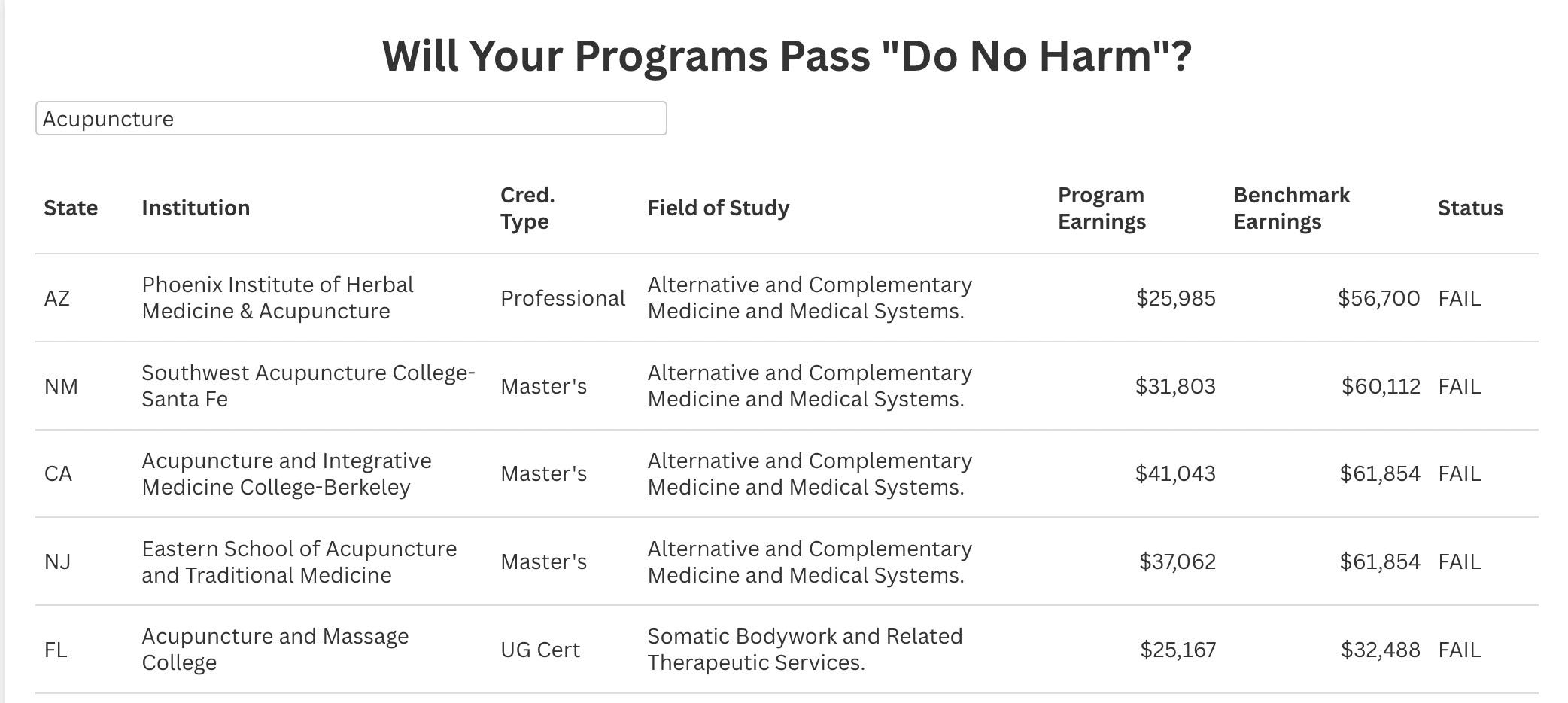
Spending four years or more getting trained and licensed only to make $35k after another four years of hard work - who would willingly choose that career path?
“The problem is not just the cost of education. It is also what too many Acupuncturists earn after graduation.”
I will eventually write more about ways to increase practitioner income.
But with the debate heating up between those pushing for lower education costs and those resisting those ideas in favor of maintaining the status quo, I thought it was time to start writing more about these debates, especially how our mainstream acupuncture organizations are responding.
The “National Standard” Model
There has long been a segment of the U.S. acupuncture profession that wanted us to unify around a single national standard:
One educational system, one licensing exam system, and one professional membership organization advocating for the interests of Acupuncturists.
The thinking behind this perspective is that a unified system would help acupuncture become more accepted within mainstream medicine.
That, in turn, would help improve insurance coverage, expand hospital-based employment, and bring greater parity with other healthcare professions.
Those who think along these lines have also tended to promote higher training standards, with education hours similar to those of other higher degree healthcare professions.
The thinking goes that higher standards would justify greater parity in pay, responsibility, and professional recognition because we can say our training is of similar rigor.
I have already written about the unfortunate infighting over education hours and do not want to revisit that history too deeply here.
I simply want to point out that alongside those advocating for national standards, there have always been others who feared that integrating too deeply into mainstream medicine could eventually dilute what makes acupuncture unique.
Over time, the national-standard perspective gained ground, and educational hours and costs rose, particularly after schools became eligible for federal student loans.
Today, most states require Acupuncturists to graduate from schools accredited by a single accrediting body (ACAHM) and pass examinations administered by a single national organization (NCBAHM).
Even California, which long maintained its own accreditation and licensing system, now uses ACAHM accreditation, and efforts continue to move California toward adopting NCBAHM exams.
Now, however, the looming loss of federal student loans has led to the emergence of a group working to develop an alternate path to education and licensure in the state of Oregon.

The “State Standard” Model
Led by the Oregon Acupuncture Association, this group has developed a thoughtful and well-researched proposal aimed at lowering educational costs while preserving a pipeline for new Acupuncturists entering the profession in that state.

This Oregon effort is meeting resistance from mainstream institutions that fear such a move would complicate or undermine decades of work toward national standards.
Things are beginning to get heated.
I hate seeing this.
“The Education Wars, our profession’s deepest self-inflicted wound, may once again be entering an acute phase.”
I share some of the concerns about the potential loss of what makes acupuncture so unique. However, I have always leaned toward the perspective that having one national standard would help acupuncture become more accepted and, ultimately, help more people.
In fact, I would personally like to see even greater consistency; one title used across all states and one entry-level scope of practice nationwide.
But here is the bottom line:
The organizations and individuals who have championed the National Standard model and pushed for higher standards have known about these coming changes to federal student loan programs for more than a decade.
Yet meaningful contingency planning was largely ignored.
Only recently has the seriousness of the situation been seriously acknowledged as seen in the 2024 formation of the Acupuncture and Herbal Medicine Coalition (AHM Coalition) - the collaborative alliance by the four mainstream AHM groups - the ACAHM, ASA, CCAHM and NCBAHM.[2]
Now, their primary strategy seems to be fighting federal policy changes to preserve the status quo while resisting efforts by others who are trying to develop contingency plans, at least within their own state.
I have spoken with people on both sides of this issue.
I believe there is still a path forward that avoids this becoming another destructive civil war within the profession.
But it could just as easily go the other way.
“We need contingency planning, not just resistance to change.”
Despite these challenges, I remain hopeful.
The profession is facing a real crisis, both in the cost of education and the low income earned by too many Acupuncturists.
But we also have many smart, thoughtful people in this profession that truly love this medicine.
I believe we will find a path through this.
As a Taoist who has spent many years studying the teachings of Lao Tzu, Chuang Tzu, and the I-Ching, I believe in the wisdom that teaches that everything changes.
The highs are followed by lows.
The lows are followed by highs.
I only hope the transition from this low point toward a better future does not become too messy.
[1] I will be writing more about the effort to get Acupuncturists into the Medicare system in future articles. Spoiler alert: We have been trying to make that happen for more than 30 years.
[2] I will be writing more about the AHM Coalition soon, likely in the next article.
RESOURCES:
Here is a link to a town hall meeting held by the Oregon Acupuncture Association to discuss their proposals for changes in the pathway to acupuncture licensure in Oregon. This gives a great summation of the issues behind the changes to federal student loans.
This link is to the Acupuncture and Herbal Medicine Coalition’s events page. Their March 18th town hall meeting is a good place to learn how these mainstream AHM groups are seeing and responding to the coming changes to federal student loans.
Both Bex Groebner of the Acupuncture Workforce Alliance and Danielle Reghi, President of the Oregon Acupuncture Association, have been doing a good job of writing articles on these issues.
Ryan Hoofer’s Substack Debt by Natural Causes digs the deepest into the whole subject of the federal loan policies. He follows the finances of all the schools and has been participating in the rulemaking process meetings under the U.S. Department of Education.