

Revisiting the Demand Issue
Saving the Acupuncture Profession While Helping Millions – Part 11

In my eighth article, I stressed that even with just modest support from the acupuncture profession for the outreach and referral campaigns I have been describing, we could raise the funds needed to greatly increase demand. In this article, I want to revisit the issue of the low demand for acupuncture services in the U.S.
I have received a good deal of positive feedback about this Substack series and am grateful for that. I did not expect to receive only positive feedback and, in fact, I welcome differing opinions. We need healthy discussions about innovative ideas if we are going to make meaningful changes and move this profession forward.
The one claim that has generated the most disagreement is my assertion that the profession’s biggest problem is the lack of demand for our services. Some have expressed the view that low demand is not really an issue, let alone our biggest issue.
Knowing there may be others who doubt that demand is a major problem, I want to look more closely at the numbers.
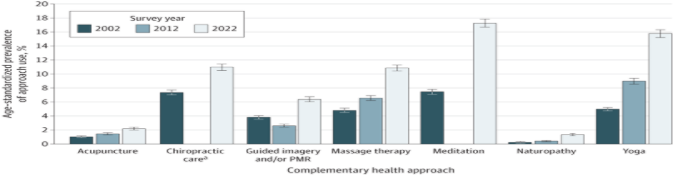
Chart from the National Institutes of Health’s most recent survey showing CAM usage indicates that just over 2% of Americans used acupuncture in 2022.
Just over 2% of Americans.
Some point to this and say it is encouraging, since usage doubled over the past 20 years, rising from around 1% to 2%.
Yes, it doubled.
From a paltry 1% to a slightly less paltry 2%.[1]
To put that into perspective, look at chiropractic. In 2022, nearly 12% of Americans received chiropractic services. In 2002, that number was nearly 8%.
That means that even 20 years ago, Chiropractors were seeing nearly four times the number of patients that Acupuncturists are seeing today. Today, they see almost six times what we see. [2]
I often hear the counterargument that the real problem is not demand, but access and cost, particularly insurance coverage. The argument goes that if insurance coverage were expanded, more people would seek acupuncture.
There is some truth in that. If coverage expanded significantly, more patients would likely seek acupuncture. But the main reason insurance companies do not expand coverage is low demand.
When only 1–2% of the population uses a service, why would insurers go through the cost and trouble to expand coverage?
Especially when they are not hearing from policyholders demanding it.
Around 30 years ago, I participated in a meeting with leaders from acupuncture organizations that had just presented data to a major insurance company showing how much money the insurer could save by covering acupuncture. They stressed that covering acupuncture would reduce the cost of the more expensive and riskier conventional medical treatments.
“You will save money,” was their pitch.
The response was clear. Saving money on the back end was not their priority. If they saw stronger consumer demand, and believed offering acupuncture would increase policy sales on the front end, then they would consider covering it. But with such low usage and no evidence of losing customers to competitors who offered acupuncture, they saw no upside.
About 15 years ago, I attended healthcare policy meeting where a representative from a major insurance company described what happened when they experimented with expanding acupuncture coverage.
Because historical demand was so low, they concluded it would cost more to develop utilization management policies to decide what to cover or not cover than to simply approve all acupuncture claims. So they began covering acupuncture with no restrictions on conditions or treatment numbers.
They automatically approved all claims.
Unfortunately, a small number of acupuncturists billed excessively and costs quickly escalated. They dropped the acupuncture benefit.
The key point is this:
It all comes back to demand.
If demand were significantly higher, the entire dynamic would change.
Insurance companies would see profit potential in covering acupuncture. Our lobbying efforts would carry more weight because they would be backed by popular demand. Hospitals and large clinics would be more inclined to hire acupuncturists. Private practices would see larger patient bases.
In my 6th article, we discussed survey findings showing that 123 million Americans are interested in receiving acupuncture in the future, and 40 million of those are very interested.
The potential demand exists.
The question is what is holding these prospective patients back, and how do we address it? I discussed how we could address this in that 6th article but that was before I learned of a study that looked at what is holding people back. Published in 2024 and titled:
“Barriers and Facilitators to Integrating Acupuncture into the U.S. Health Care System: A Scoping Review”[4] This study looks closely at the barriers to acupuncture being integrated into the U.S. health care system. The number one barrier they found was:
“The most pervasive barrier to the use of acupuncture as a treatment option was a lack of knowledge and awareness of acupuncture. Lack of awareness was also a factor for physicians and other allied health professionals and patients who were medically underserved. Three studies showed that both providers and the general population were unaware of evidence supporting the use of acupuncture. Negative perceptions and beliefs about acupuncture arose when people did not have a clear understanding of acupuncture. Participants reported having fears about the side effects of acupuncture.”
This is what I have been saying all through this series of articles. The number one barrier is lack of information. I have been laying out ways we could address this lack of information. We still need to do surveys and message testing, but this study supports what should have been obvious: The number one barrier holding people back is lack of information about acupuncture.
Gaining support for outreach education campaigns to increase demand and by that increasing Acupuncturists’ income is what this whole series of articles has been about.
I have argued that with well-designed and properly funded outreach and referral campaigns, we could double the number of people seeking acupuncture within the next few years.
Some, maybe even most, believe that’s not possible.
But chiropractic history suggests otherwise.
Between 2000 and 2003, chiropractors saw a 57% increase in patient usage.[3]
Media coverage about CAM usage, largely driven by Harvard’s Dr. David Eisenberg’s studies on CAM usage, played a major role. Public awareness was raised. Integrative programs began appearing. Curiosity grew.
People began thinking:
“If so many others are using these services, maybe I should look into that as well.”
Boom. Fifty-seven percent growth in four years.
If we doubled acupuncture usage, we would still only be at roughly half the utilization rate Chiropractors had 20 years ago.
That is not unrealistic.
Two percent is not enough.
Waiting 20 years in hopes that it gradually rises to 4% is not a strategy.
Acupuncturists treat a wider variety of conditions than Chiropractors. Even with fewer practitioners, our usage rate should not be this far behind.
We need to do something different from what we have been doing.
This series of articles lays out ideas for addressing that.
What do you think?
[1] In my original draft of this sentence, I used the word “pathetic” to describe the level of acupuncture demand but decided to change that to “paltry”. I’m not so sure that pathetic was not closer to the truth.
[2] Yes, I realize that there are about twice the number of Chiropractors than Acupuncturists, but that still means Chiropractors are seeing more than double the number of patients per practitioner than Acupuncturists are.
[3] According to data from the Medical Expenditure Panel Survey (MEPS) and published in Utilization and Expenditures on Chiropractic Care in the United States from 1997 to 2006
[4] Barriers and Facilitators to Integrating Acupuncture into the U.S. Health Care System: A Scoping Review. Available from: https://www.researchgate.net/publication/382828271_Barriers_and_Facilitators_to_Integrating_Acupuncture_into_the_US_Health_Care_System_A_Scoping_Review